Saturday, June 13, 2015

The ecology of economies

Econology Part 2: The ecology of economies

[This is a rewrite of two earlier posts which have been pulled together into one. The originals are still here but I think this is more cohesive.]

Economists, pundits and policy makers like to pontificate about the state of the economy. They often toss terms like ‘invisible hand of the market’, ‘free market’ and ‘market forces’ as if they are self-explanatory or common knowledge. They are not. These terms don’t explain why wages have not gone up when consumer prices have. They don’t explain the housing bubble or the banking crisis. They don’t justify factory closures or layoffs when their products are selling well. Economies and markets affect every aspect of our lives and yet there isn’t a cogent explanation of how or why this is so. That is the goal of this series of essays - to offer a cogent explanation of economies and markets. An informed public is an empowered public.

***

[This the most recent addition of a series describing a new way to look at the economy. It is not necessary to read Parts 1a and 1b to but they place this discussion in context:

Part 1a: It's not the economy, Stupid; it's economics

Part 1b:The depth and breadth of economies]


All economies have elements in common. They can all be divided into two parts, a system of production (economic systems are different systems of production) and a market (mechanisms by which producers compete to exchanged their goods and services). And all systems of production have some degree of inequality as a consequence of specialization. Differences in skills can be readily depicted with a pyramid diagram where the bulk of lower skilled workers form the base and the remainder of the pyramid by progressively fewer, more specialized workers until until terminating (Figure 1).


A pyramid representing an economy is actually a pyramid of pyramids: economies contain all the pyramids of all the organizations within its purview. The smaller organizational pyramids, in turn, contain the households of their workers (Figure 2A). Organizations are classified by their ownership model. Sole proprietorships have one owner while those with more than one owner can be further split into two classes, capitalist enterprises (by definition, for-profit commercial enterprises) and non-capitalist enterprises (all non-profit and some for-profit organizations) (Figure 2B).


The majority of workers, the ‘makers’ at the base of the pyramid (Figure 2A) make the marketable output (goods and services) produced by any specific commercial entity (for example, schools provide education; factories produce widgets; hospitals provide health care services; think tank produce analysis, etc.). The upper portions of the pyramid are, broadly speaking, inhabited by specialized ‘organizers’ (Figure 2A). They do not directly produce the marketable output but instead, plan and implement strategies to increase the productivity of workers and maximize the market return on worker productivity. Amongst their responsibilities is to direct the flow of capital; organize advertising strategy (marketing) and organize other organizers (executives).

[Note: Capital means all goods and services which can be exchanged for currency. This includes labor, wages, materials, consumer products, land, structures, equipment and currency.]

A universal truth of productivity and capital flow in all organizations and ultimately, any economy, is that the goods and services produced by makers are new capital (Figure 3), thus makers are the primary source of capital. The objects of economic exchange are all products of worker labor and their value is a function of the amount of labor inputted. For instance, dirt and water are essentially free for owners of land with dirt and water and have little market value. Bricks made out of dirt and water have market value and structures built of bricks have an even higher value. The difference between dirt and soil from bricks is the worker labor stored in bricks. Brick structures have an even greater input of worker labor which significantly increases their value over bricks alone. The value of services tend to reflect the extent of education and training necessary to learn specific skills. Skills which can be learned in a matter of hours (using a cash register) are less valuable than those needing extensive education (medicine or law). In return for their labor, workers are compensated a portion of the value of the goods and services they produce. By a similar process, the organizers ensure the productivity of workers or lower level organizers and are compensated a portion of the value of the goods and services made by workers. In other words, workers make stuff; organizers make workers make stuff.


The structure of production and direction of capital flow applies to all enterprises, both sole proprietorships and multiple owner enterprises. For single owner enterprises, the authority to make decisions lies completely in the owner. In multiple owner enterprises, the power to determine the distribution of worker produced capital is highly variable. On one end of the spectrum are capitalist enterprises where capitalist owners of the equipment and materials transformed by worker makers, hold ultimate power (Figure 4). They authorize lower level organizers to carry out their decisions. And because the raison d’etre of capitalist enterprises is to maximize profit (i.e., workers pushed to produce as much as possible and owners retain as much worker produced capital as they can), it is the fiduciary duty of executives/owners to minimize wages paid to workers and non-executive organizers so larger and larger portions of worker made capital is distributed to the owners.


There is greater diversity in the power structure of non-capitalist enterprises (Figure 2B). Some follow the strict top down model of capitalist organizations. At the other extreme, power is equally divided amongst all members - each has equal say (for this essay, socialism refers to this model). In a fully socialist system, worker owners use equipment they collectively own to transform materials they collectively purchase into finished goods. Communication occurs across all strata of workers and organizers (Figure 5) resulting in an equitable distribution of worker produced capital (Figure 6).


To recap… (I) Pyramid shape reflects the unequal distribution of skills and/or wages of working people. (II) The least skilled workers produce the majority of goods and services (capital). (III) In any given institution, power can either be concentrated in a limited number of owners (capitalists) or diffused among the large aggregate pool of worker owners. (IV) Distribution of worker made capital is determined by wielders of power.

As it turns out, economies aren’t the only entities with these four elements. Natural terrestrial (land) communities form ecological pyramids with similar traits (Figure 7): (I) The biomass at each tier, or trophic layer, reflects the relative population at each tier. (II) The organisms at the base the pyramid produces the calories (biological capital) which support all the higher strata (Figure 8).


In natural ecosystems, plants are the makers/primary producers - they make more plants (vegetative calories) from simple inorganic carbon and water with sunlight. Herbivores (secondary producers) consume vegetation (vegetative calories) to grow and reproduce (make more herbivorous calories). Carnivores consume herbivores (herbivorous calories) to grow and reproduce (make more carnivorous calories). This pattern, the products of each trophic (ecological production) layer consumed by those above, continues along the trophic pyramid to peak with apex predators. Only primary producers (autotrophs) are capable of transforming simple inorganic carbon into organic carbon (like turning mud into bricks); all other subsequent trophic levels are comprised of heterotrophs which cannot make use of inorganic carbon; they consume organic carbon (cannot turn mud into bricks, can reshape and stack bricks). Directly or indirectly, the existence and maintenance of all the plants and animals in a food web depends on plant productivity (Figure 8).

Then there is the higher order similarity between ecological food pyramids and economic production pyramids. They encompass the individual biological entities and food chains within an ecosystem (Figure 9A) like an economic pyramids contain the collective households and enterprises of an economy (Figure 2A). Additionally, individual food chains can be differentiated by the biological interactions they use to collect the calories necessary to sustain life (Figure 9B), much like business structures in economies (Figure 2B).


Carnivorous predation, for one, is an antagonistic biological relationship; essentially the calorie transfer described above. In a food chain with a predator at its apex (Figure 10), food calories move up the food chain and power is effected downwards in that predators determine if prey will be able to continue producing - eating prey destroys their capacity to produce; power over life and death… A lot like capitalism. Biomass (calories) produced by prey is consumed (taken in) by predators. Predators exert ultimate control over prey (see traits III & IV of economic pyramids).


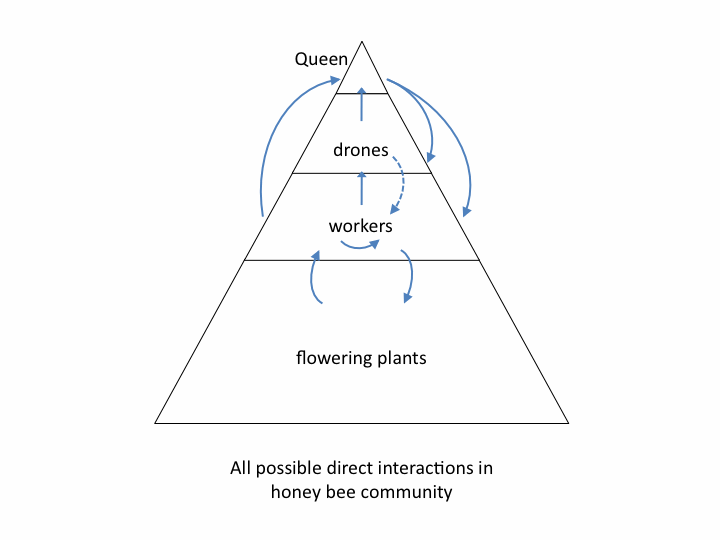
Mutualism, an example of facilitative interactions where no participant is harmed and some participants benefit (Figure 9B) is common in social insects where the activity of each member of a community benefits the community in total (see traits III & IV of economic pyramids). Take for example, a honey bee community (Figure 11)...


In the case of honey bees, flowering plants (primary producers) and bees have a mutually beneficial relationship; the plants provide nectar and pollen in exchange for the pollination services of bees. The bees within a beehive community also have a mutually beneficial relationship. Bees at each strata carry out duties which contribute to the survival of the community as a whole. And while it may not be known how bees communicate or if there are strict lines of power, coordinated bee behavior suggests communication occurs. These include mating flights (queen and drones act in concert); egg and larvae care (feed needs to be appropriate to developmental needs of larvae); locating nectar sources (scout bees communicate direction and perhaps abundance to other bees); processing nectar (pooling of nectar and its concentration into honey requires coordinated effort by workers). The honey produced and stored by worker bees is thought to be available to all members of the colony… A lot like socialism. Production is a collective effort and seemingly no single authority regulates the distribution of goods (see traits III & IV of economic pyramids).

Capitalism and socialism have ecological equivalents. What about other economic systems? As it happens, sole proprietorships behave like autotrophs, organisms capable of generating their own calories; thievery is a form of parasitism; feudalism is capitalism constrained by mobility (predation in habitats where limits on nutrient availability restricts mobility of inhabitants - oases; deep sea vents; caves; whale falls); various forms of slavery are variants of capitalism (predation) or ‘zombie’ parasitism where parasites alter the behavior of hosts (Table 1). Given the diversity of biological interactions in the natural world, it is more difficult to identify an economic system without an ecological analog than a biological interaction without an economic analog.


***

Having established that economic modes of production are analogous to ecological modes of production, perhaps the ecological market might shed light on what economic markets are and their role in the economy.

But what is the ecological market? Economic market activity can be tracked by following the movement of capital but ecological capital (organic calories) don’t exit the production pyramid; they are created and consumed within food webs. Fortunately, there are two nutrients which traverse food webs much like capital moves in economic production, carbon and water. And as it turns out, water and economic capital (money) share some unusual features (Table 2): (1) Like currency, water is fungible (to a living organism, there is no difference between water sipped from a puddle or water in hay). (2) Money figuratively transforms into goods and services through market exchange, analogous to the literal transformation of water as it traverses the water cycle. (3) The supply of money limits economic growth and activity much like the water supply limits ecological productivity (the abundance of water is likely the single most significant factor in determining total ecosystem biomass and diversity).


Figure 12 shows how food webs makes use of the geochemical  water cycle to capture the water necessary to sustain and grow itself.


As plants are sessile and cannot seek water, it must be delivered to them by rainfall. Water taken up by plants is incorporated (or biochemically transformed) into more plant mass. At this point, the water either stays in the form of plants (plants grow/propagate) or is eaten by something else or is metabolized to meet the energy needs of the plant (transpiration). In the first two, the water stays in the food web (Figure 12A, B); in the last, water is released into the air as water vapor (Figure 12E). A similar process happens in plant predators, the herbivores (Figure 12B). They eat water containing plants and transform the plant (and water within) into herbivore mass; the water, now in the form of herbivores either stays herbivore, is preyed on by a predator (Figure 12C) or gets metabolized (respiration) for energy (Figure 12E). This pattern continues through the food chain until it reaches the apex (Figure 12D) where water is seldom loss to predation.

Water vapor lost from the food pyramid by transpiration, respiration and evaporation (Figure 12E) merges with water vapor in the atmosphere [evaporated from soil/bodies of water (Figure 12I)] to coalesce into clouds (Figure 12G). Water holding clouds are buffeted by winds until meteorological conditions triggers a precipitation event. Rain water is released back into the environment to re-enter the ecological pyramid and recharge natural reservoirs. The bulk of the water on the planet is not locked into food webs but contained in natural reservoirs (Figure 12I). Flora and fauna rely on these reservoirs to survive periods of drought. Natural reservoirs also store untapped capital to support growth in times of expansion.

Capital plays the same role in economies (Figure 13) as water does in ecosystems…


[Notes: ‘Economic cycle’ refers to the cycling of capital through economic production and markets as depicted in Figure 13, not cycles of expansion and contraction. The latter will be referred to explicitly or as the ‘business cycle’.]

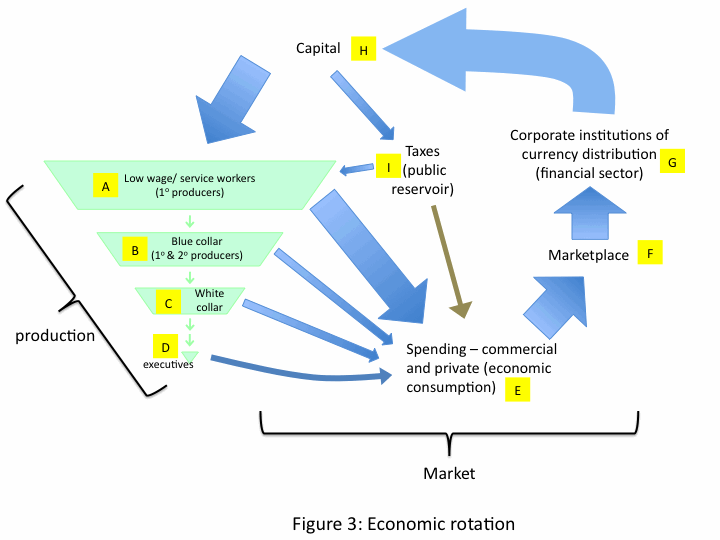
Figure 13 depicts movement of capital from its raw form entering the production stream (Figure 13, arrow H to A) where it is transformed into marketable capital (goods and services) by primary producers (Figure 13A). Marketable capital can either stay with the primary producers (Figure 13A, B) - as savings; be taken up by the next tier of workers (Figure 13B, C); or spent by workers (Figure 13E) on their own behalf. The amount taken up by the next tier of workers (Figure 13B, C) is decided by the power brokers within organizations. The spending and saving patterns of workers (Figure 13A, B and E) reflect how workers dispose of their incomes to meet their needs. The next tier of workers (Figure 13B, C) retains a portion of the marketable capital as income for their contribution to the production of marketable capital (an example of secondary production might be an inventory of primary production). These wages also undergo the three way split: retention by secondary producers (Figure 13C, D); lost to the next tier of workers (Figure 13C, D); or spent to support their well-being (Figure 3E). Capitalists and owners at the apex of the production pyramid either retain (Figure 13D) or spend (Figure 13E) their takings; there is no other loss.

Spending in the marketplace (Figure 13F) is where the capital exchange occurs (goods and services exchanged for money and vice versa). Central banks (Figure 13G) control the value of currency and commercial banks (Figure 13G) track and transfer capital (Figure 13H). Purchased capital (Figure 13H) always traverses the production pyramid to reach its buyer because the purchasing capital is produced by the workers at the lower production tiers. Capitalists (Figure 13D) purchase goods with the cumulative capital produced by all other producers in the pyramid (Figure 13A, B, C & D).

Central and commercial banks (Figure 13G) are the 'clouds' (Figure 12G) of economies: they determine the availability of capital (thus its value) through interest rates; they concentrate capital; they mediate transformation of capital (currency into stocks/bonds); and they facilitate the transfer of capital between and amongst institutions and economies. Likewise, governments (Figure 13I) mimic natural reservoirs (Figure 12I) in that they buffer capital flow during cycles of expansion and contraction and they are stewards of the capital reserves that fuel future growth.

[In a cyclical system, the precise start and end points are arbitrary because, in the end, they meet at the same place. An equally legitimate read of the cycle would have workers making widgets (Figure 13A, B, C). Executives sell widgets in marketplace for money (Figure 13E, F, G). Taxes are paid to the government (Figure 13H -> I) before wages are paid to workers (Figure 13H -> A, B, C, D).]

Tables 3 and 4 summarize the similarities between economies and ecosystems.


***

Part 3 will delve into the lessons the water cycle teaches about economies.

Econology Part 3: Eleven economics lessons from ecosystems.

Wednesday, June 10, 2015

Endemic police violence

Redditt Hudson, a black former cop, wrote this article detailing the culture of racism flamed violence in American police departments. He tells an awful story that's well worth reading. He writes:
"On any given day, in any police department in the nation, 15 percent of officers will do the right thing no matter what is happening. Fifteen percent of officers will abuse their authority at every opportunity. The remaining 70 percent could go either way depending on whom they are working with. "
So rooting out the 15% of abusive cops would go far to fixing the problem.

I wonder if private insurance could be an effective tool to stem police misbehavior. I am not clear if municipalities self-insure against the professional conduct of their police. Cities have had to pay out large sums to victims of police violence. What would happen if each police officer were required to carry individual police conduct insurance? (Compare this to malpractice insurance that doctors need to practice medicine.) Who actually pays for the insurance coverage is not as important as the insurer adds a layer of independent oversight. Insurance providers don't want to pay claims; they won't insure officers with a record of misconduct. It might just work as a tool to weed out the bad cops and warn the others that big brother is watching (when they're on duty, that is).


Sunday, May 3, 2015

The geochemistry of markets

Econology Part 2b: The geochemistry of markets

This is the next part of a series arguing that existing economic theory is insufficient to solve the inherent systemic problems of the economy.

In my last post/diary, I made the case that economic systems are analogs of biological interactions; specifically, capitalism is a form of predation and socialism is a variant of facilitative relationships. Here, I will extend the analogy and discuss how the geochemical portion of the ecological nutrient cycle is functionally equivalent to markets.

***

[If you haven’t read Part 2a, please do. This essay builds on that discussion.

Econology Part 1a: It's not the economy, Stupid; it's economics

Econology Part 1b: Econoctopus: the deep, insidious tentacular nature of economies

Econology Part 2a:The biological interactions of economic production]


In the earlier parts of this series, economics was used as a familiar portal to introduce unfamiliar ecological concepts. This time, a familiar ecological phenomena will be the portal to a different (possibly unique) perspective on the structure of economies.

As mentioned in the introduction, economic production is similar to ecological food webs.


But economies are not only about production; knowing how stuff is made does not say much about how is it traded. And as a layperson, I have difficulty connecting the strands of the economic, sociological and anthropological elements of markets into a coherent metaphor that explains the relationships between markets, production and human welfare.

This is where the ecological food web can offer some insight. The strong parallels between economic production and food chains suggests the entire ecological nutrient cycle is analogous to economies. Given that stable functioning ecosystems are healthy due to the balance of biological productivity and species diversity, they may model how analogous economic elements interact and provide a comprehensive overview of economies work.

The most obvious way to do this is to follow the traffic of ecological capital (organic calories) inside and outside the food web. But organic calories don’t really exit the food web; they are created and consumed for energy within food webs. Fortunately, there are two nutrients which traverse food webs much like capital moves in economic production… carbon and water. And as it turns out, water share several important traits with economic capital (money): (1) water is fungible (to a living organism, there is no difference between water sipped from a puddle or water in hay); (2) water can and does undergo literal transformation (see below) as it traverses the water cycle; and (3) water is rate limiting to ecological productivity (the abundance of water is likely the most significant factor in determining total ecosystem biomass and diversity). In comparison, economic capital (money) is (1) fungible; (2) although economic capital does not literally (chemically) transform from one form of matter to another form of matter, the market exchange of money for goods and services makes the goods/services explicitly equivalent to money; and (3) the availability of money limits economic growth and activity.


Figure 2 shows how food webs are able to make use of the movement of water through the environment.


As plants are sessile and cannot seek water, it must be delivered to them by rainfall. When it rains, water is taken up by plants and incorporated or biochemically transformed into more plant mass. At this point, the water either stays in the form of plants (plant growth or propagation) or is eaten by something else (predation) or is metabolized to meet the energy needs of the plant (transpiration). In the first two, the water stays in the food web (fig 2-1); in the last, water is released into the air as water vapor (fig 2-5). A similar process happens in plant predators, the herbivores (fig 2-2). They eat water containing plants and transform the plant matter (and water within) into herbivore mass (becoming secondary producers); the water, now in the shape of herbivores either stays herbivore, is preyed on by a predator (fig 2-3) or gets metabolized (respiration) for energy (fig 2-5). This pattern continues through the food chain until it reaches the apex (fig 2-4) where water is seldom loss to predation.

As biological entities, we humans are more interested in the biologically productive portion of the water cycle; however, the bulk of the water cycle is attributable to global geochemical forces. Atmospheric water vapor [mostly from evaporation from soil/bodies of water (fig 2-9) in addition to food web transpiration/respiration (fig 2-5)], coalesces into clouds (composed of liquid droplets or ice crystals) (fig 2-7). Water holding couds are buffeted by the winds until the meteorological conditions trigger their release as precipitation.

This pattern of events also occurs in economies…


[In this discussion, economic capital encompasses all goods and services which can be exchanged for currency, including labor, materials, consumer products, land, structures, equipment and currency. This equivalence allows capital movement to be condensed to a uni-directional single stream flow analogous to the passage of water in a terrestrial ecosystem.]

As shown in figure 3, capital (materials, tools and equipment) enters the production stream for workers (fig 3A&B) to transform into marketable capital (goods and services). Upon production, marketable capital either stays with the primary producers (fig 3A&B) - as savings; is taken up by the next tier of workers (fig 3B/C); or is spent by workers (fig 3E) on their own behalf. The amount taken up by the next tier of workers (fig 3B/C) is decided by the power brokers within organizations. Spending and saving of workers (fig 3A/B&E) reflect how workers dispose of their incomes to meet their needs. The next tier of workers (fig 3B/C) retains a portion of the marketable capital as income for their contribution to the production of marketable capital (an example of secondary production might be an inventory of primary production). These wages also undergo the three way split: retention by secondary producers (fig 3C/D); loss to the next tier of workers (fig 3C/D); or spending to support their well-being (fig 3E). Executives and owners at the apex of the production pyramid either retain (fig 3D) or spend (fig 3E) their takings; there is no other loss.

Spending in the marketplace (fig 3F) is where the capital exchange occurs (trade goods and services for money and vice versa). The financial sector (fig 3G) tracks and transfers capital (purchased goods and services) (fig 3H) to buyers. Purchased capital (fig 3H) always traverses the production pyramid to reach its final destination because the purchasing capital is produced by the workers at the lower production tiers. Executives (fig 3D) purchase goods with the cumulative capital produced by all other workers (fig 3A, B, C & D).

Banks and financial institutions behave in economies in ways similar to clouds in the water cycle (fig 3G): they concentrate capital; they mediate transformation of capital into different states of matter (currency into stocks/bonds); and they facilitate transfer of capital between and amongst institutions and economies. Likewise, governments (fig 3I) mimic natural reservoirs by buffering capital flow during periods of expansion and contraction.

[Another way to read the economic rotation: Workers make widgets (fig 3A/B/C). Executives sells widgets in marketplace for money (fig 3E, F, G). Taxes are paid to the government (fig 3H -> I) before wages are paid to workers (fig 3H -> A, B, C, D).]


---

Part 2 of this series highlighted the similarity between economies and ecological water cycles. The respective capital of both systems serve the same purpose in their respective systems; the individual elements (transpiration/respiration & spending, clouds & financial institutions) perform analogous functions and even the distinct bifurcation of the water cycle by biological and geochemical forces resembles the division between economic production and markets. It would be fair to conclude that, at minimum, one is a metaphor of the other and they may ascend to the level of analytically pertinent models (though it would be difficult to determine which is the model due to the complexity of both systems).

The next part will explore how the water cycle can shed light on economies.

Econology Part 3: The ecology of economies.

Tuesday, April 28, 2015

Privilege

When rioting broke out during the protests of Freddie Gray's death (he sustained life threatening injuries while in the custody of the Baltimore police), a mother was caught on tape disciplining her son when she found him participating in the unrest. She apparently told a reporter, “That's my only son and at the end of the day I don't want him to be a Freddie Gray." This is a prime example of white privilege... how often do white parents need to train their kids to be fully conciliatory to police under all circumstances?

And not to diminish the African-American experience, this also brought to mind a recent report of a Maryland couple getting in trouble for allow their children to 'free range'. Privilege came to mind again.

As people, young and old, we all want the privilege of safety wherever we happen to be. Women want to be free of cat calls when walking on a public street; children want to be free (of predators) to play safely anywhere they choose to; people of all stripes want to be free of harassment (police and otherwise) when they are not doing anything illegal and free of excessive force when restrained for any reason; everyone should be free of fear that they may be targeted by a gun totting second amendment 'supporter'. And we should have the expectation of freedom from electronic monitoring unless specifically and explicitly permitted through legitimate and open judicial review.

It is a poor reflection on our founding fathers that rights once conferred by the Constitution are now privileges afforded to select citizens.

Wednesday, April 8, 2015

The biological interactions of economic production

Econology Part 2a: The biological interactions of economic production

[If you haven't read the earlier installments of this series, please do. It is much easier to follow in order:

Econology Part 1b: It's not the economy, Stupid; it's economics

Econology Part1b: Econoctopus: the deep, insidious tentacular nature of economies

Note: I am neither an economists nor environmental/ecologic specialist. In reading and experiencing the economic turmoils of recent years and decades, I have noticed some parallels which I set out to describe in this series. They offer an alternative and perhaps unique lens through which to view the impact economics has on the world.]

In a previous post, I used a factory as a metaphor for the environment. A deeper look into the structure of ecosystems would reveal the relationship is actually reversed: environments are not copies of factories, rather factories copy ecosystems; specifically, economic systems mimic biological interactions of calorie transfer.

***

Economies all have common elements. One is the separation of systems of production (or economic systems) from markets (the mechanisms by which producers compete to exchanged their goods and services - to be covered in the next part). Another is inequality, a consequence of specialization. Differences in skills can be readily illustrated with a pyramid with the bulk of similar skilled working people forming the base and the remainder filled in with progressively fewer, more specialized working people.


A pyramid representing an economy is actually a pyramid of pyramids: economies contain all the pyramids of all the organizations within its purview; the smaller organizational pyramids, in turn, contain the households of their workers. Furthermore, organizations with more than one owner can be divided into two classes, capitalist enterprises (by definition, for-profit commercial enterprises) and non-capitalist enterprises (all non-profit and some for-profit organizations).


The majority of working people, the 'makers', form the base of the pyramid; they are the source of the products and services, the marketable output, of organizations. (for example, schools provide education; factories produce widgets; hospitals provide health care services; think tank produce analysis, etc.) The top portion of the pyramid is, broadly speaking, inhabited by specialized 'organizers'. They do not directly participate in the making of goods and services but instead, plan and implement strategies to increase the productivity of workers and maximize market return on worker productivity. Amongst their responsibilities is to direct the flow of capital; organize advertising strategies (marketing) and organize the organizers (executives).

[Note: Capital means all goods and services which can be exchanged for currency. This includes labor, materials, consumer products, land, structures, equipment and currency.]

A universal truth of productivity and capital flow in all organizations and ultimately, any economy, is that the goods and services produced by the makers is the primary source of all capital. The subjects of economic exchange are all products of worker labor and their value is a function of the amount of labor input. For example, dirt and water are essentially free for owners of land with dirt and water and have little market value. Bricks made out of dirt and water have market value and structures built of bricks have an even higher value. The difference between dirt and soil from bricks is the worker labor stored in bricks. Brick structures have an even greater input of worker labor which significantly increases their value over bricks alone. The value of services tend to reflect the extent of education and training required. Job skills which can be learned in a matter of hours (using a cash register) are less valuable than those needing extensive education (medicine or law). In return for their labor, workers are compensated a portion of the value of the goods and services they produce. By a similar process, the organizers earn their portion of the value of the goods and services produced by workers as compensation for ensuring the productivity of workers or lower level organizers. In other words, workers get paid to make stuff (paid with the stuff they make); organizers are paid to make workers make stuff (paid with stuff workers make).


The structure of production and direction of capital flow holds for all enterprises, both sole proprietorships and multiple owner enterprises. For single owner enterprises, the authority to make decisions lies completely in the sole owner. In multiple owner enterprises, the power to determine the distribution of worker produced capital is highly variable. On one end of the spectrum are capitalist enterprises where capitalists, as owners of the equipment and materials transformed by worker makers, hold ultimate power. They authorize lower organizers to carry out their decisions. And because the raison d’etre of capitalist enterprises is to maximize capital return on capital invested (i.e., workers produce as much as possible and owners retain as much worker produced capital as possible), it is the duty of executives/owners to minimize wages paid to workers and non-executive organizers so larger and larger portions of worker made capital is distributed to the owners.


There is greater diversity in the power structure of non-capitalist enterprises. (Non-capitalist enterprises can be broadly divided into (a) for-profit single share ownership - by workers - enterprises or (b) non-profit government or independent institutions.) Some follow the strict top down model of capitalist organizations. At the other extreme, power is equally divided amongst all members - each has equal say. (For this essay, socialism refers to this model.) In a fully socialist system, worker owners use equipment they collectively own to transform materials they collectively purchase into finished goods. Communication occurs across all strata of workers and organizers and worker produced capital is distributed according to a formula negotiated by all worker owners.


To recap… (1) Pyramid shape describes inequality of skills and wages of working people in economies, institutions and households. (2) The least skilled workers account for the majority of goods and services (capital) produced by various institutions. (3) In any given institution, power can either be concentrated in a limited number of owners or diffused among a large aggregate pool of worker owners. (4) Distribution of worker made capital is determined by holders of power.

As it turns out, economies aren’t the only entities with these four features. Living terrestrial communities form ecological pyramids with similar traits: the biomass at each tier or trophic layer reflects relative population of actors (1) and those at the base the pyramid produces the calories or ‘capital’ (2) which support the higher strata.


In natural ecosystems, plants are the makers and producers - they make more plants from simple inorganic carbon and water with sunlight (produce vegetative calories). Herbivores consume vegetation (vegetative calories) to grow and reproduce (make more herbivorous calories). Carnivores consume herbivores (herbivorous calories) to grow and reproduce (make more carnivorous calories). This pattern, the products of each trophic layer consumed by those above it, continues along the trophic pyramid to peak with apex predators. Only primary producers (autotrophs) are capable of transforming simple inorganic carbon into organic carbon (turn mud into bricks); all other subsequent trophic levels are comprised of heterotrophs and cannot make use of inorganic carbon; they must consume organic carbon (cannot turn mud into bricks, can reshape and stack bricks). Directly or indirectly, the existence and maintenance of all the plants and animals in a food web depends on plant productivity.

And just as economic pyramids are the collective households and enterprises of an economy, an ecological pyramid encompasses the individual biological entities and food chains within an ecosystem. Additionally, individual food chains can be differentiated by the biological interactions or strategies they use to collect the calories necessary to sustain life.


For instance, an example of an antagonistic biological relation is predation; essentially the biological interactions described above. In a food chain with a predator at its apex, food calories move up the food chain and power flows downward in that predators determine if prey will be able to continue producing - eating prey destroys their capacity to produce; authority over life or death… A lot like capitalism. Biomass produced by prey is consumed (taken in) by predators; predators exert ultimate control over prey (3 & 4).


Facilitative interactions where no participant is harmed and some participants benefit are well represented by social insects where the activity of each member of a community benefits the community in total (3 & 4). Take for example, a honey bee community...


In the case of honey bees, flowering plants (primary producers) and bees have a mutually beneficial relationship; the plants provide nectar and pollen in exchange for the pollination services of bees. The bees within a beehive community also have a mutually beneficial relationship. Bees at each strata carry out duties which contribute to the survival of the community as a whole. And while it may not be known how bees communicate or if there are strict lines of power, coordinated bee behavior suggests communication occurs. These include mating flights (queen and drones act in concert); egg and larvae care (feed needs to be appropriate to developmental needs of larvae); locating nectar sources (‘scout’ bees communicate direction and perhaps abundance to other bees); processing nectar (pooling of nectar and its concentration into honey requires coordinated effort by workers). The honey produced and stored by worker bees is thought to be available to all members of the colony… A lot like socialism. Production is a collective effort and seemingly no ultimate authority regulates the distribution of goods (3 & 4).

But it is not only modern economic systems (capitalism and socialism) which mimic ecological interactions. Sole proprietorships are equivalent to autotrophs, organisms capable of generating their own calories; thievery is a form of parasitism; feudalism is a variant of capitalism constrained by mobility (predation in habitats where limits on nutrient availability restricts mobility of inhabitants - oases; deep sea vents; caves; whale falls); various forms of slavery are variants of capitalism (predation) and ‘zombie’ parasitism where parasites alter the behavior of hosts. Given the diversity of biological interactions in the natural world, it is more difficult to identify an economic system without a natural analog than a biological interaction without an economic analog.


But historically, economies and economic systems are not static. Feudal economies evolved into capitalism (Western Europe) or were forced into socialism (Eastern Europe, China) and the world economies are currently in the midst of globalization. On a smaller, institutional level, other economic mechanisms modulate the extremes of capitalist and socialist structures. Unions are a means by which workers communicate with executives/owners which introduces a socialist element into capitalist ventures. Privatization of non-capitalistic institutions injects capitalist ideology into institutions and organizations which traditionally have goals other than generating profit.

To further explore the implications of these changes, Part 3 of this series will detail the role of markets and their relationship to production in the context of analogous ecological relationships.


Continued in Econology Part 2b: The geochemistry of markets.

Friday, April 3, 2015

The Iran nuclear deal is so bad, it should be applied to the financial industry

There's a framework of a deal with Iran over nuclear weapons. A deal is needed because a nuclear Iran threatens the stability of the Middle East. And there's a lot of rumbling over how bad it is. In fact, it's so bad, the banks which threaten the stability of the economy (in fact, they all but collapsed the economy and have taken serious shots at our cities) should be held to the same standards...

***
[Note: My only contribution to the text below is in red.]

Parameters for a Joint Comprehensive Plan of Action Regarding the Islamic Republic of Iran's Nuclear Program

Below are the key parameters of a Joint Comprehensive Plan of Action (JCPOA) regarding the Islamic Republic of Iran’s nuclear program that were decided in Lausanne, Switzerland. These elements form the foundation upon which the final text of the JCPOA will be written between now and June 30, and reflect the significant progress that has been made in discussions between the P5+1, the European Union, and Iran. Important implementation details are still subject to negotiation, and nothing is agreed until everything is agreed. We will work to conclude the JCPOA based on these parameters over the coming months.


(Roughly equivalent terms for financial industry)

Enrichment (sale of Risky Financial Instruments - RFI)

    Iran has agreed to reduce by approximately two-thirds its installed centrifuges. Iran will go from having about 19,000 installed today to 6,104 installed under the deal, with only 5,060 of these enriching uranium for 10 years. All 6,104 centrifuges will be IR-1s, Iran’s first-generation centrifuge. (reduce RFI sales force)
    
    Iran has agreed to not enrich uranium over 3.67 percent for at least 15 years. (set limits on sale of RFIs)
    
    Iran has agreed to reduce its current stockpile of about 10,000 kg of low-enriched uranium (LEU) to 300 kg of 3.67 percent LEU for 15 years. (reduce numbers of RFIs)
    
    All excess centrifuges and enrichment infrastructure will be placed in IAEA monitored storage and will be used only as replacements for operating centrifuges and equipment. (store excess RFIs in warehouse guarded by regulators)
    
    Iran has agreed to not build any new facilities for the purpose of enriching uranium for 15 years. (no new financial instruments research arms for 15 years)
    
    Iran’s breakout timeline – the time that it would take for Iran to acquire enough fissile material for one weapon – is currently assessed to be 2 to 3 months. That timeline will be extended to at least one year, for a duration of at least ten years, under this framework. (extend spread risk of likely tanking economy 40 time periods into the future)

Iran will convert its facility at Fordow so that it is no longer used to enrich uranium (convert equivalent fraction of RFI sales force to other purposes)

    Iran has agreed to not enrich uranium at its Fordow facility for at least 15 years. (converted sales force from above is banned from RFI sales for 15 years)
    
     Iran has agreed to convert its Fordow facility so that it is used for peaceful purposes only – into a nuclear, physics, technology, research center. (converted sales force from above can only sell safe investments)
    
    Iran has agreed to not conduct research and development associated with uranium enrichment at Fordow for 15 years. (no new financial instruments research arms for 15 years)
    
    Iran will not have any fissile material at Fordow for 15 years. (converted sales force from above cannot handle or support sales of RFIs for 15 years)
    
    Almost two-thirds of Fordow’s centrifuges and infrastructure will be removed. The remaining centrifuges will not enrich uranium. All centrifuges and related infrastructure will be placed under IAEA monitoring.


Iran will only enrich uranium at the Natanz facility, with only 5,060 IR-1 first-generation centrifuges for ten years.

    Iran has agreed to only enrich uranium using its first generation (IR-1 models) centrifuges at Natanz for ten years, removing its more advanced centrifuges.
    
    Iran will remove the 1,000 IR-2M centrifuges currently installed at Natanz and place them in IAEA monitored storage for ten years.
    
    Iran will not use its IR-2, IR-4, IR-5, IR-6, or IR-8 models to produce enriched uranium for at least ten years. Iran will engage in limited research and development with its advanced centrifuges, according to a schedule and parameters which have been agreed to by the P5+1.
    
    For ten years, enrichment and enrichment research and development will be limited to ensure a breakout timeline of at least 1 year. Beyond 10 years, Iran will abide by its enrichment and enrichment R&D plan submitted to the IAEA, and pursuant to the JCPOA, under the Additional Protocol resulting in certain limitations on enrichment capacity.

Inspections and Transparency
(to be overseen by Financial regulators)

    The IAEA will have regular access to all of Iran’s nuclear facilities, including to Iran’s enrichment facility at Natanz and its former enrichment facility at Fordow, and including the use of the most up-to-date, modern monitoring technologies. (regulators will have regular access to all commercial facilities)
    
    Inspectors will have access to the supply chain that supports Iran’s nuclear program. The new transparency and inspections mechanisms will closely monitor materials and/or components to prevent diversion to a secret program. (regulators will have regular access to all records and contracted work)
    
    Inspectors will have access to uranium mines and continuous surveillance at uranium mills, where Iran produces yellowcake, for 25 years.
    
    Inspectors will have continuous surveillance of Iran’s centrifuge rotors and bellows production and storage facilities for 20 years. Iran’s centrifuge manufacturing base will be frozen and under continuous surveillance. (access of regulators good for 20 years)
    
    All centrifuges and enrichment infrastructure removed from Fordow and Natanz will be placed under continuous monitoring by the IAEA.
    
    A dedicated procurement channel for Iran’s nuclear program will be established to monitor and approve, on a case by case basis, the supply, sale, or transfer to Iran of certain nuclear-related and dual use materials and technology – an additional transparency measure. (establish clean and clear channels of outside contracting/contracts)
    
    Iran has agreed to implement the Additional Protocol of the IAEA, providing the IAEA much greater access and information regarding Iran’s nuclear program, including both declared and undeclared facilities.
    
    Iran will be required to grant access to the IAEA to investigate suspicious sites or allegations of a covert enrichment facility, conversion facility, centrifuge production facility, or yellowcake production facility anywhere in the country. (regulators can inspect other suspicious sites)
    
    Iran has agreed to implement Modified Code 3.1 requiring early notification of construction of new facilities. (regulators require early notification of expansion/resumption of RFI research/sales)
    
    Iran will implement an agreed set of measures to address the IAEA’s concerns regarding the Possible Military Dimensions (PMD) of its program.

Reactors and Reprocessing (Redesign RFIs to be safe financial instruments with reasonable guarantee of return)

    Iran has agreed to redesign and rebuild a heavy water research reactor in Arak, based on a design that is agreed to by the P5+1, which will not produce weapons grade plutonium, and which will support peaceful nuclear research and radioisotope production.
    
    The original core of the reactor, which would have enabled the production of significant quantities of weapons-grade plutonium, will be destroyed or removed from the country.
    
    Iran will ship all of its spent fuel from the reactor out of the country for the reactor’s lifetime.
    
    Iran has committed indefinitely to not conduct reprocessing or reprocessing research and development on spent nuclear fuel.
    
    Iran will not accumulate heavy water in excess of the needs of the modified Arak reactor, and will sell any remaining heavy water on the international market for 15 years.
    
    Iran will not build any additional heavy water reactors for 15 years.

Sanctions (Rescind charter(s) of non-compliant banking and financial institutions; place non-compliant banking and financial institutions under Receivership; restrict access of non-compliant banking and financial institutions to funds from Frederal Reserve)

    Iran will receive sanctions relief, if it verifiably abides by its commitments.
    
    U.S. and E.U. nuclear-related sanctions will be suspended after the IAEA has verified that Iran has taken all of its key nuclear-related steps. If at any time Iran fails to fulfill its commitments, these sanctions will snap back into place.
    
    The architecture of U.S. nuclear-related sanctions on Iran will be retained for much of the duration of the deal and allow for snap-back of sanctions in the event of significant non-performance.
    
    All past UN Security Council resolutions on the Iran nuclear issue will be lifted simultaneous with the completion, by Iran, of nuclear-related actions addressing all key concerns (enrichment, Fordow, Arak, PMD, and transparency).
    
    However, core provisions in the UN Security Council resolutions – those that deal with transfers of sensitive technologies and activities – will be re-established by a new UN Security Council resolution that will endorse the JCPOA and urge its full implementation. It will also create the procurement channel mentioned above, which will serve as a key transparency measure. Important restrictions on conventional arms and ballistic missiles, as well as provisions that allow for related cargo inspections and asset freezes, will also be incorporated by this new resolution.
    
    A dispute resolution process will be specified, which enables any JCPOA participant, to seek to resolve disagreements about the performance of JCPOA commitments.
    
    If an issue of significant non-performance cannot be resolved through that process, then all previous UN sanctions could be re-imposed.
    
    U.S. sanctions on Iran for terrorism, human rights abuses, and ballistic missiles will remain in place under the deal.

Phasing (agreement is binding for times stated within)

    For ten years, Iran will limit domestic enrichment capacity and research and development – ensuring a breakout timeline of at least one year. Beyond that, Iran will be bound by its longer-term enrichment and enrichment research and development plan it shared with the P5+1.
    
    For fifteen years, Iran will limit additional elements of its program. For instance, Iran will not build new enrichment facilities or heavy water reactors and will limit its stockpile of enriched uranium and accept enhanced transparency procedures.
    
    Important inspections and transparency measures will continue well beyond 15 years. Iran’s adherence to the Additional Protocol of the IAEA is permanent, including its significant access and transparency obligations. The robust inspections of Iran’s uranium supply chain will last for 25 years.
    
    Even after the period of the most stringent limitations on Iran’s nuclear program, Iran will remain a party to the Nuclear Non-Proliferation Treaty (NPT), which prohibits Iran’s development or acquisition of nuclear weapons and requires IAEA safeguards on its nuclear program.

Wednesday, April 1, 2015

Bathroom transphobia, a cure

I've seen a number of articles recently about transgender children and attempts to regulate their bathroom use per gender. One way to completely resolve these issues is to convert all public bathrooms to unisex... it would void transphobic hysteria with hysteria about general sexual predation. At least the latter is more credible.